Year 11 Mathematics, Set 2
- Topic
- Quadratics, weeks 5 to 6
- Tutor
 Sage · hints first
- Sources
- Department notes v3 Approved
- Paper 1, question 4 Approved
- Worksheet 4 Approved
Tutix for schools
A live class with a multimodal AI tutor that talks with each student, sees their work as they do it, and remembers them with Cog+.
Coming soonTutix for schools is coming soon. Every class, name and figure drawn on this page is a sample.
Sample classYear 11 Mathematics, with Sage
Students speak and the tutor answers aloud, like a video call.Captions are there if a student wants them. It is a live voice conversation, not a chat box.
The whiteboard, worksheets and a shared screen.As pictures a few seconds after each change. There is no camera in either direction.
Cog+ keeps where each student got stuck.So their next class starts with the tutor already knowing, and anything unfinished carries forward.
A live class is not a chat box. The student and the tutor put the lesson on a shared stage, and the tutor sees what is on it.
Use the prepared lesson deck as the agenda.
Lesson styles that lean toward it: Guided lesson, Exam prep
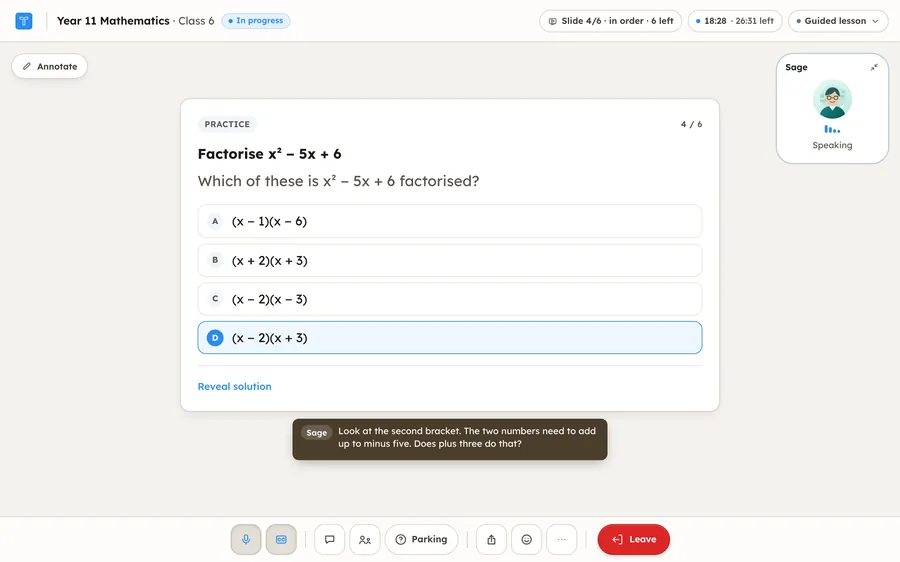
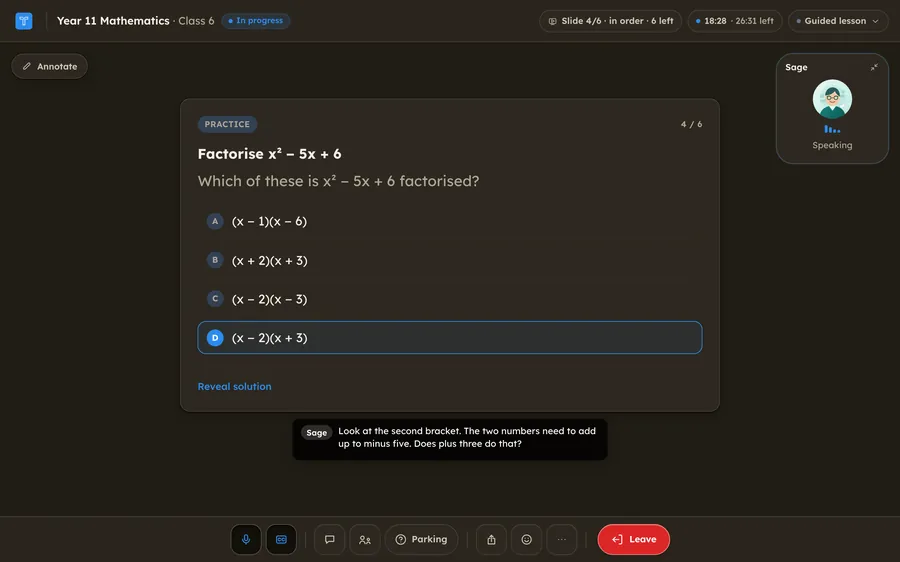
Work through problems like a shared notebook.
Lesson styles that lean toward it: Practice-heavy
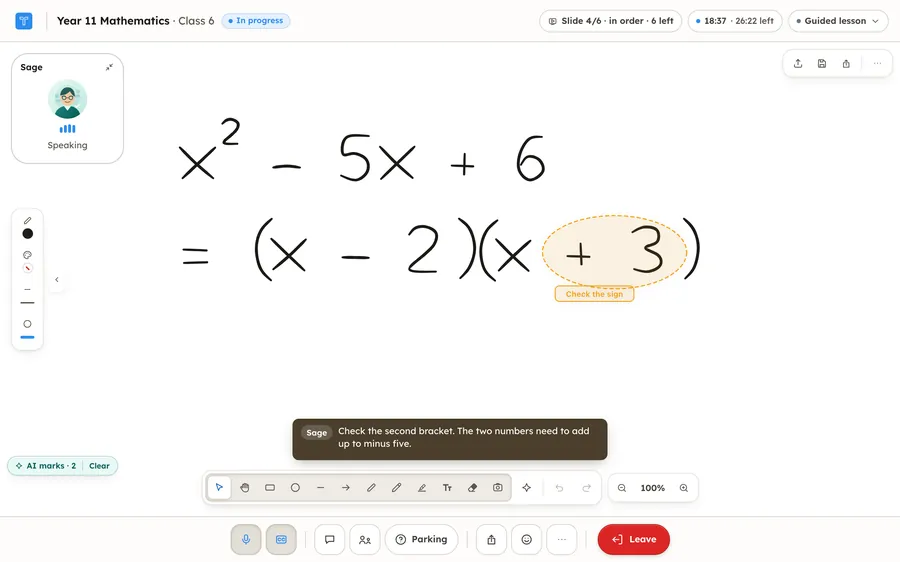
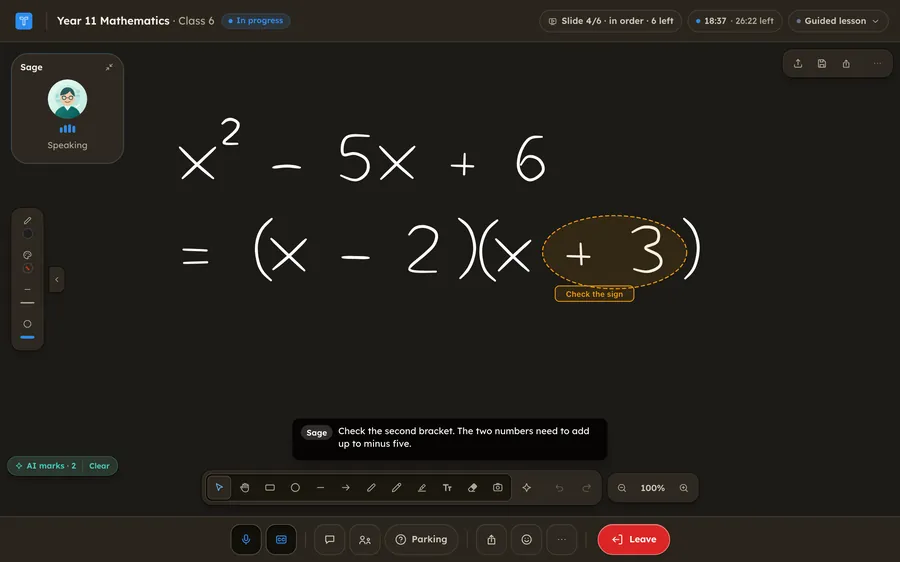
Write, revise, and keep shared class notes.
Lesson styles that lean toward it: Review, Writing feedback
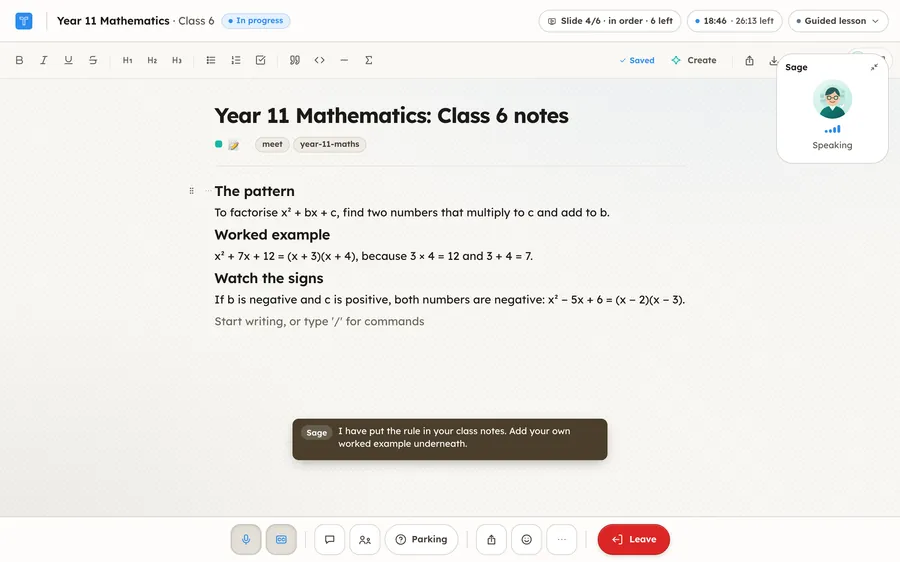
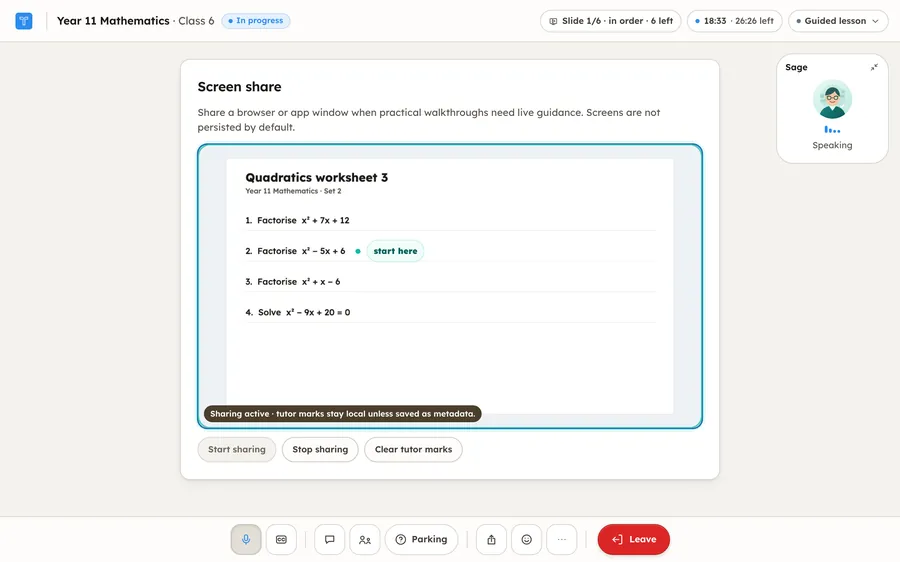
Let the tutor see a browser or app window.
Lesson styles that lean toward it: Practical walkthrough
Upload a PDF, DOCX, or PPTX and mark it up together, page by page.
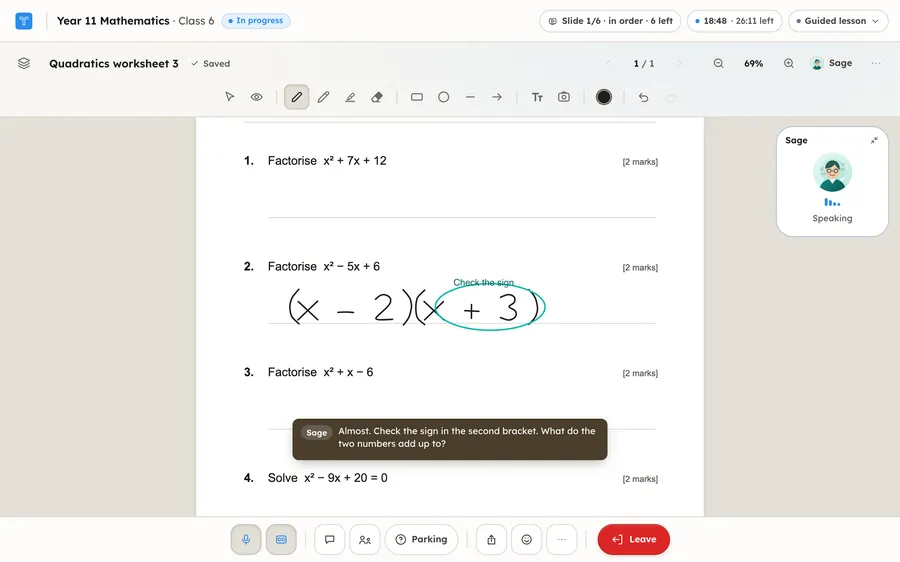
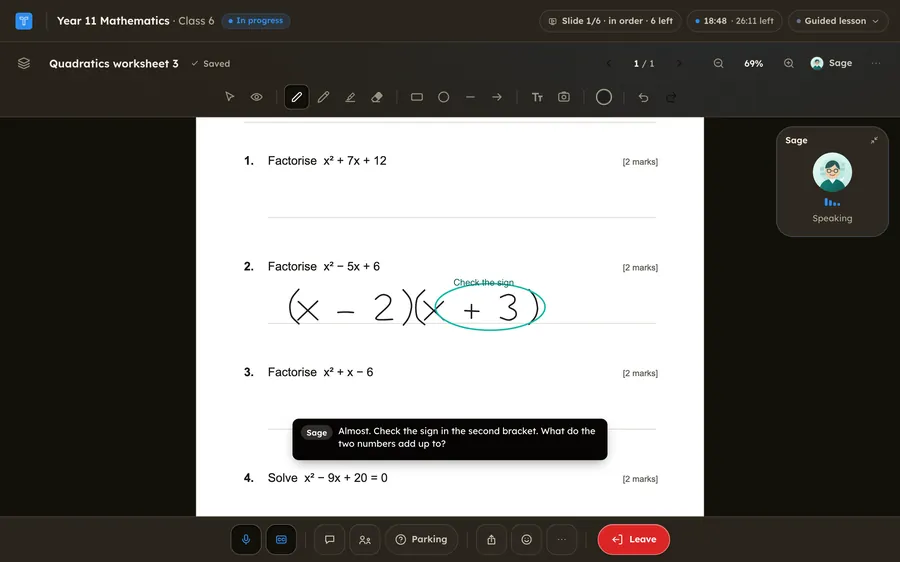
The student opens Share and picks what goes on stage. The tutor can change it too, when the lesson needs a different surface. Whatever is on stage, the tutor can see it and talk about it. There is no camera in either direction, and a student’s own marks on a slide stay private.
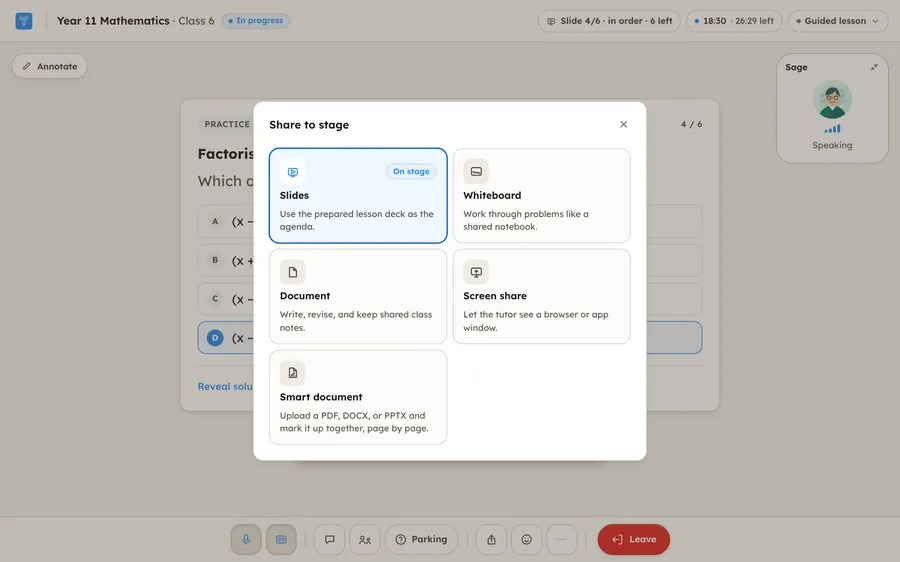
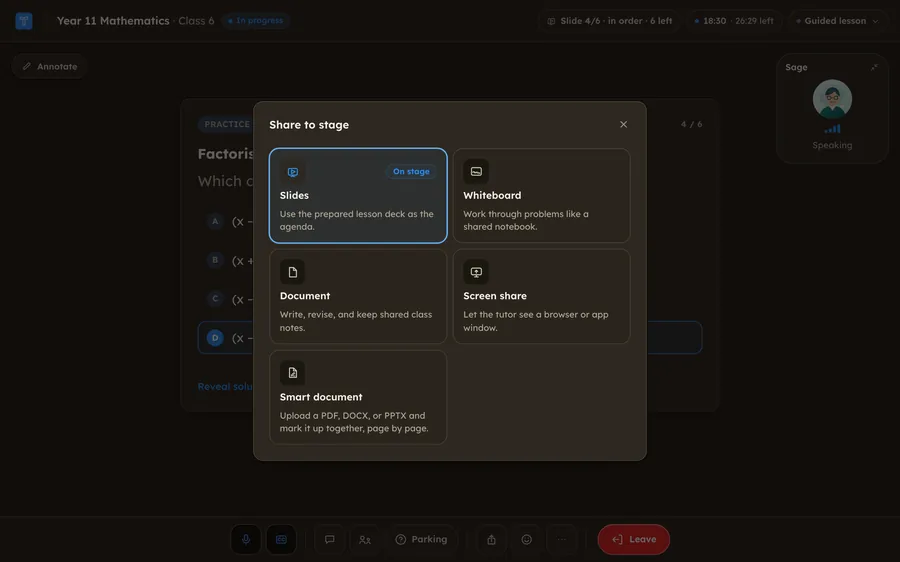
The lesson style is the rhythm the tutor teaches in. It leans toward the mode that suits it, and never locks one, so a student can still switch. Today it is chosen when a class is set up and can be changed from the top bar in the room.
Coming soonChoose which modes a class allows, and put a worksheet or past paper on the stage for every student.
Choose the sources, the week and how the tutor should teach. You test it as a student before anyone else sees it.
The tutor talks them through the plan aloud and sees their working as they write it.
It marks the slip on the page as the student writes, and the working it came from stays with the work.
Where the class got stuck, what to teach next, and the evidence behind it.
Year 11 Mathematics, Set 2
Sage · hints first
Practise factorising
Paper 1 · Question 4[2 marks]
Factorise x² − 5x + 6
(x − 2)(x + 3− 3)
1/2
Both brackets are negative. The numbers multiply to +6 and add to −5.
Class brief
Eight students wrote the wrong sign in the second bracket, and three did it twice. A two-minute worked example before Tuesday’s lesson should fix most of it.
Build a tutor from your notes, syllabus, worksheets and past papers. Showing the exact page in each answer is coming soon.
Sample answers Spoken in class, with captions on
You askedWhy do both numbers have to be negative?
The numbers multiply to +6, so they share a sign. They add to −5, so both are negative.
Department notes v3 · page 4
You askedWill this come up in the mock?
That is outside the material your teacher approved for this unit. Your teacher has been told.
Noted for your teacher
Choose the approach, the hints and when answers appear. Test it as a student before anyone else sees it.
SageYear 11 Mathematics
Preview as a student
Approach
How do I factorise x² − 5x + 6?
Hint 1 of 3. Look at the last number. Which pairs multiply to give 6?
What two numbers multiply to 6 and add to −5?
Find two numbers that multiply to 6 and add to −5. They are −2 and −3, so it is (x − 2)(x − 3). Try x² + 7x + 12 next.
Plan the term, set the week, and let catch-up cover absences.
Term 2 · Year 10 Science
Students practise by topic or sit a full paper, and the tutor marks the working on the page. Marking against your own mark scheme, with marks you can change, is coming soon.
Paper 1 · Question 7[3 marks]
Solve x² + 3x − 10 = 0
Set each bracket to zero: x + 5 = 0 gives x = −5.
2/3
Mark scheme
Marked by SageChange a mark
Where a student got stuck in a class becomes a small note called a cog. Cogs link, merge and fade, so the tutor starts each class knowing that student’s weak spots.
Where a student got stuck in a class is kept as a small note called a cog.
SampleMixed up the sign of the second bracket
Related cogs link, and repeated ones merge into one weak spot. Things a student has mastered fade, so the memory stays current.
Negatives under an operation4 cogs · 68%
SampleFour sign slips became one weak spot worth a lesson
The next class starts with the tutor already knowing the student’s biggest weak spot, and any topic that was not finished carries forward.
SampleThursday’s class picked up the unfinished factorising, with the sign slips in mind
Counted measures sit beside the tutor’s reading of them, and every reading opens onto the work behind it.
Year 11 Mathematics, Set 2
Tutor’s reading
Eight students wrote the wrong sign in the second bracket. Three did it twice. A two-minute worked example before Tuesday’s lesson should fix most of it.
Counted this week
In the product, every figure here is counted from the work.
Suggested group for Tuesday 8 students
Same slip, same fix. About ten minutes.Add to the plan
Voice and text, captions and reading support, and a plain account of who can see what. No camera in either direction.
Paper 1 · Question 4[2 marks]
Factorise x² − 5x + 6
Sage · speaking
SageLook at the last number. Which pairs multiply to give six?
Choose a voice for the class
 NovaSage
 Spark
Spark Atlas
Atlas Pixel
Pixel Echo
Echo Bolt
BoltOr a plain tutor, set by your school, with no name or face. Coming soon
A teacher’s own voice Coming soon
Your own address and sign-in, permissions you set, and a budget with a cap. The workspace is coming soon to the Enterprise plan.
Every school will get its own tutix.ai address, its own name and its own sign-in. Type yours and see it written into the letter to staff.
Your school
Dear colleagues,
Our classes now use Tutix. Sign in with your school account at
yourschool.tutix.ai
using Google Workspace or Microsoft Entra ID. Only people with an account at our school can sign in. You will see your own classes, and students will see theirs.
Roles are set by the school and checked on every request. Leaders see totals. Teachers see their own classes. Nobody has access to everything by default.
Roles and permissions
“School policy” means the school decides, the student is told, and every opening is logged.
The school’s tutoring is one bank of minutes. Set a cap, give departments their share, and be told before anything runs out.
Invoice INV-0412
PO 4471 · September · Sample school
| Banked minutes | Amount |
|---|---|
| 230,400 minutes (3,840 hours) at $55 per 1,000 | $12,672.00 |
| Total due | $12,672.00 |
Assigned to students so far38% of the bank
Mathematics520 hScience374 hEnglish237 hHistory148 hComputing108 hLanguages72 hMinutes last 12 months from purchase. Unused minutes stay banked.
77 features for schools. Available now, or coming soon to the Enterprise plan.
Every school gets a proposal built around its students, its features and its tutoring hours. This is where proposals start, in US dollars. For comparison, one hour with a private tutor typically costs $35 to $100.
$18–$24per student, per month
$36–$45per student, per month
$50–$75per 1,000 minutes
Indicative only. From 500 students volume pricing applies, so the real figure is lower. Your proposal is the price.
89
randomised trials of tutoring, reviewed together, found about 0.29 standard deviations of extra learning.
Nickow, Oreopoulos and Quan, American Educational Research Journal, 2024. This is the case for tutoring in general. It is not a result we are claiming for Tutix.
1,000+
people have completed a Tutix class.
These quotes are samples, not from customers. We will replace them with words from schools, used with their permission.
I want a tutor that teaches my way and shows me where the class got stuck. That’s the part I never have time for.
It shows me the exact line where I went wrong, and it remembers for next time.
I get a short note after every class. For the first time I know what my son found hard this week, in words I understand.
We are registering schools for early access. Tell us who you are and how many students you have in mind.
Coming soonSchool accounts are not open yet.
We learn your curriculum, your systems and the students you have in mind.
One department or year group, with real classes and a teacher who helps shape it.
We look at the evidence together: what students did, what teachers read, what it cost.
More classes, then the school, with training for every teacher who joins.
We are registering schools for early access now. The school plan is in the later phases of development and should be out within the next month. Your proposal will say what is ready and when.
Every school gets a proposal. As a guide, about $18 to $24 per student per month for Core and $36 to $45 for Plus, or banked minutes at $50 to $75 per 1,000, lower for bigger purchases and good for 12 months. Prices are in US dollars, with teacher and admin accounts included. Volume pricing applies from 500 students.
By default the tutor gives hints before answers, though a student can ask for the solution or reveal it on a practice slide. Teacher rules for how many hints a student gets, for when an answer appears and for locking the tutor during assessments are coming soon.
Coming soon: practice and results, and a short summary of each session. A full conversation opens only where your school’s policy allows it, the student is told, and the opening is logged. School leaders see totals, never a conversation.
It hears them when they speak, and it sees what they put on the stage: the whiteboard, a page of a worksheet or a window they share, as pictures a few seconds after each change. There is no camera in either direction. A student’s own notes on a slide stay private to them.
The live tutor speaks and understands English. Screen share needs a desktop browser, and the tutor sees a shared screen as pictures, not video.
We use the Department for Education’s generative AI product safety standards as our reference checklist: filtering and monitoring, hints before answers, session limits and a plain tutor your school can choose. Several are coming soon, and we do not claim certification. Your proposal says where each one stands.
The school plan is for students aged 10 and over, enrolled by the school with its consent. It is coming soon. Individual Tutix accounts are for students aged 13 and over.
We aim for WCAG 2.2 AA and have not had an independent audit yet. Captions are available today. Larger text, read-aloud, dyslexia-friendly text, high contrast and extra time are coming soon.
Coming soon: with their school Google Workspace or Microsoft Entra ID account, on your own tutix.ai address. Roster sync, other providers and your own domain are coming soon too.
Yes, for a tutor you build today: up to ten sources, such as PDFs, documents and slides. Past papers and mark schemes need the right permissions from their publisher. Page-level citations and department source packs are coming soon.
That is the plan, and it is coming soon: school learning and personal study stay separate, and the school sees nothing from a student’s own study.
Any subject, taught in English. Tell the tutor your course and goals, or give it your own notes and papers, and it plans the series and follows what you teach, whatever the exam board. Ready-made exam-board syllabuses are coming soon.
You can try the student experience today with a free class, up to 45 live minutes a month. Memory across classes is lighter on the free plan. A pilot for your school can be part of the proposal.